
The initial planning meetings went smoothly. Schedules were confirmed, roles were defined, and the plan made sense on paper. Two weeks later, the customer wasn’t upset about the work itself; they were uneasy because they no longer knew where things stood in the field service delivery.
Projects often begin with genuine optimism. Customers feel aligned, confident, and hopeful about what’s ahead. As delivery gets underway, however, that confidence can start to dip. This shift rarely comes from a lack of effort or competence on the delivery team’s side.
It happens because visibility fades.
Not all at once, but in small, compounding ways that change how the work feels from the customer’s perspective. Most often, it shows up as:
- Delays that catch customers off guard, even though work is actively moving forward
- Schedules that are set, but don’t provide a clear picture of what to expect next
- Communication that reacts to issues instead of proactively reinforcing progress and direction
Individually, these moments seem manageable. Together, they quietly erode confidence long before anyone questions the plan itself.
Why Confidence Drops Before Anything Actually Goes Wrong: The “U Effect”
This pattern is often called the “U Effect.” The early phase brings optimism, but as expectations meet real-world constraints, such as the permit guy not showing up again, confidence tends to dip. Customers feel like progress is slowing even while teams are actively working behind the scenes. That dip isn’t a failure. It’s a signal that visibility and structure haven’t kept pace with the work. Root Causes: Unclear or shifting expectations and a working rhythm that hasn’t formed yet.
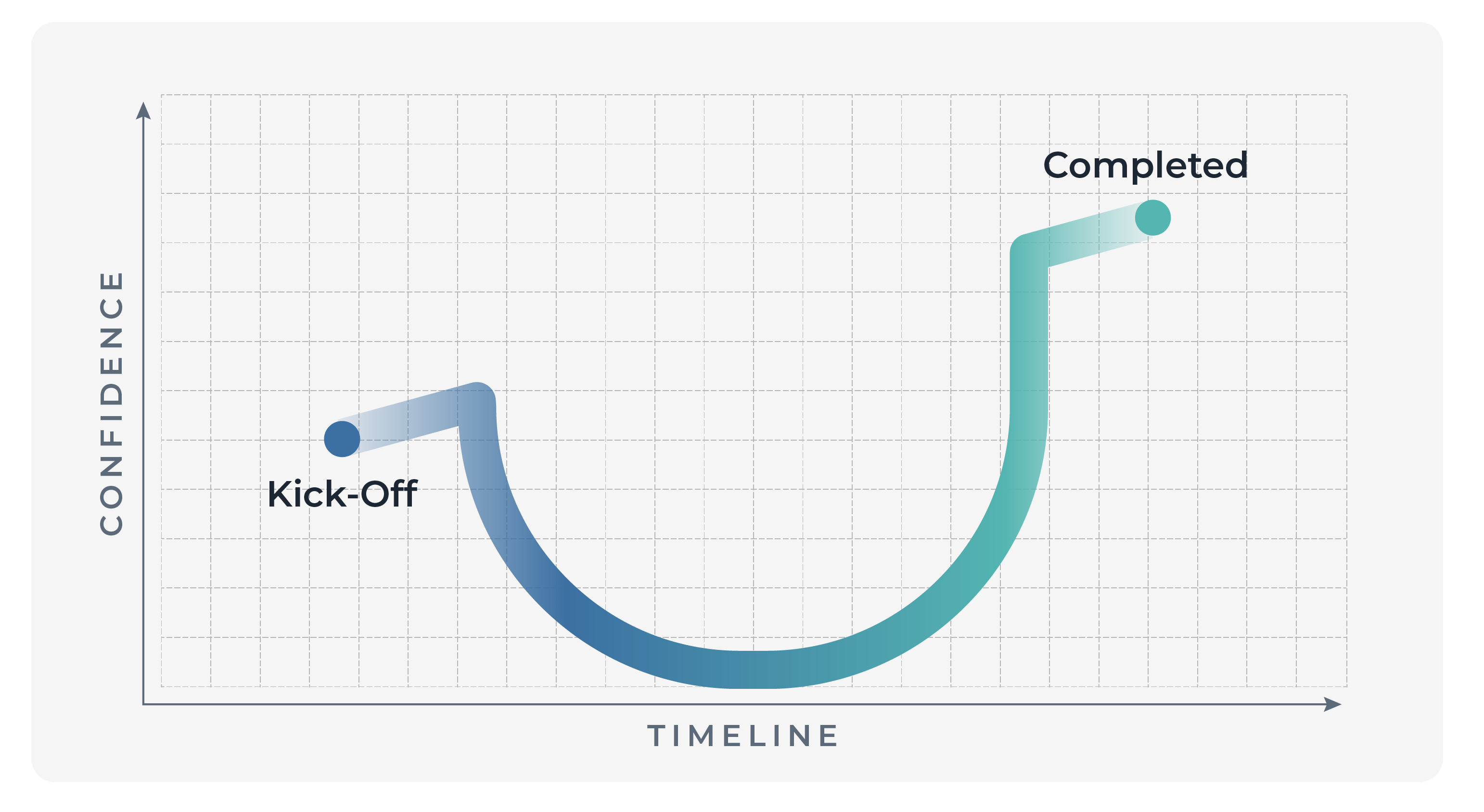
What makes this dip especially challenging is how easy it is to miss from the inside. Internally, plans are still on track, service and operational rallies are happening, and progress is being made. But from the customer’s perspective, uncertainty has already set in. That gap, when everything appears fine internally while frustration grows externally, is where hidden pain begins to surface.
Hidden Pain: When Everything Looks Fine Internally, But the Customer Is Unhappy
This is where the confidence dip becomes visible, not in missed milestones or broken delivery, but in how the process feels to the customer.
Customers don’t grow frustrated because the work is wrong. They grow frustrated when the experience of delivery feels:
- Manual
- Confusing
- Opaque
- Slow
- Dependent on them chasing updates
When visibility is limited, customers are left interpreting silence and gaps on their own. And too often, that interpretation skews negative.
The most common contributors include:
- Scattered communication and inconsistent handoffs between teams
- Spreadsheets and disconnected systems that fragment information
- Customers fill in the blanks with worst-case assumptions when updates aren’t clear or timely
Internally, progress may be steady. Externally, uncertainty has already taken hold. This hidden pain doesn’t show up in status reports—but it shapes how confident customers feel long before the project is complete.
Modern Expectations Have Changed
When customers are left filling in the gaps, it’s not because they’re impatient—it’s because their expectations have been shaped elsewhere.
Gone are the days of “it’ll get here when it gets here.” Today’s customers bring expectations shaped by a very different world. They’re used to clarity without asking, updates without chasing, and progress they can see in real time.
Companies like Amazon didn’t just raise the bar. They reset it.
Real-time tracking, proactive notifications, and transparent timelines have become the baseline for how work is experienced; not just in e-commerce, but everywhere. That expectation doesn’t disappear when a job becomes more complex. It carries over into projects, work orders, and multi-stage service delivery.
Field service customers expect the same for projects, work orders, and multi-stage jobs:
- Where are we today?
- What’s next?
- What changed and why?
- What risks should I know about?
If your systems can’t match the clarity customers expect from everyday digital experiences, frustration fills the gap.
This isn’t a demand for perfection. It’s a demand for visibility. Customers don’t expect everything to go exactly as planned. They expect to be informed, reassured, and kept in the loop when it doesn’t.
Visibility Gaps That Create the Dip
When customers expect clarity but delivery systems can’t provide it, frustration doesn’t come from poor communication alone. It’s rooted in operational blind spots that prevent teams from seeing (and sharing) the full picture.
These gaps don’t just slow work. They distort confidence.
Critical Dependency Blindness:
Teams often lack real-time visibility into dependencies that determine whether work can actually move forward, such as:
- Permit approvals
- Materials availability
- Subcontractor timelines
When those dependencies slip, schedules look stable on paper while progress stalls in reality—leaving customers confused about what’s really happening.
Planning vs. Execution Misalignment:
Dispatch, project managers, field teams, and finance frequently operate from different sources of truth. As a result:
- Staffing decisions are made without full context
- Schedules drift from actual field conditions
- Labor forecasts become unreliable
- Customer commitments are missed or quietly adjusted
Internally, teams compensate. Externally, customers see inconsistency.
Hidden Margin Erosion:
Operational blind spots don’t just impact experience; they quietly affect project health:
- Change orders go unbilled or delayed
- Manual field-to-office handoffs slow updates
- Materials and inventory are lost, misallocated, or reconciled too late
What starts as a visibility problem becomes a confidence problem—for customers and internal teams alike.
These gaps are rarely caused by people or effort. They’re the byproduct of disconnected systems trying to support increasingly complex work. And until those systems are aligned, the confidence dip remains inevitable.
The Cure: Connected Project Delivery
Connected project delivery brings people, plans, and progress together into a single shared view. When everyone sees the same story unfolding, teams stay aligned, and customers feel confident from start to finish.
- A connected system enables teams to:
- Elevate work orders into structured projects when jobs become complex
- Align schedules, materials, and dependencies in one place
- Give technicians real-time visibility into what’s ready and what’s not
- Sync field updates instantly into the project plan
- Provide finance with immediate labor and material data
- Track inventory availability and truck stock without manual intervention
- Prevent revenue leakage from missed or delayed change orders
It’s where uncertainty gives way to clarity. Teams stop guessing and start moving forward with shared confidence.
Delivering the Modern Customer Experience
With connected delivery, communication stops feeling rushed and starts feeling reassuring. Customers aren’t left wondering what’s happening, and teams aren’t scrambling to explain it. Progress is visible, confidence is steady, and the work feels supported on both sides of the project.
- What modern customers value:
- Automated updates on schedule changes, progress, or delays
- Accurate appointment windows with notification if ETA shifts
- Predictable billing events tied to actual project milestones
- Self-service options, such as portals or customer communities
- Two-way communication for rescheduling or updating job details
None of this is futuristic. It’s already what customers experience in their everyday lives. From package deliveries to ride arrivals, people are used to visibility, timely updates, and knowing what’s coming next. When projects offer the same clarity and reassurance, confidence follows naturally. Connected delivery simply brings that everyday expectation into project work. It’s meeting customers where they already are, not asking them to wait for something better.
Turning the Dip Into a Straight Line
When teams operate in connected systems and communicate proactively:
- Customer trust stays intact
- Projects feel smoother
- Internal teams stay aligned
- Margin leakage drops
- Customers finish the project not just satisfied, but confident
At the heart of every project is a simple need: to feel informed, supported, and confident along the way. When delivery is connected, that feeling lasts from the first conversation to the final handoff. Customers don’t have to wonder what’s happening, teams don’t have to chase answers, and progress feels steady instead of stressful. In a world where clarity is already a part of everyday life, connected delivery helps projects feel human again. And that’s what keeps trust intact long after the work is done.